Thursday, November 13, 2014

The Ancient city of Jerash

Sometimes referred to as the "Pompeii of the Middle East" because of the staggering amount of ruins that have been unearthed, we went next to the ancient city of Jerash. 

This Greco-Roman city was founded by Alexander the Great in 331 BCE, though the area was inhabited as far back as 3200-1200 BCE. The Romans conquered the city in 63 BCE. The archway seen below, the Arch of Hadrian, is the Southernmost entrance to the city and was built to celebrate the visit of Emperor Hadrian in 129/130 BCE. 
A huge earthquake in 749 AD destroyed most of the city, and the ruins weren't disovered again until 1806. 
Still visible on the foundations of many of the structures are wonderful mosaic floors. 
And looking closely at the picturre below, you can see truly incredible detail that's been carved into the stone- especially on the 3 small block at the top, center. 
Looking at this picture, you can see the enormous Oval Forum surrounded by columns, and the roads that branch off from it.
There is another large Roman amphitheater here, with wonderful accoustics. Below is the stage.   
There are also several churches that were built on in later years, and again the detail that can be found in some of the remaining mosaic floors is stunning. 


This temple was never fully completed, but was dedicated to the goddess Artemis. Another, above the Oval Forum, was dedicated to Zeus. 
The roads were all paved at one time, and columns flanked either side. 
This stairway led from the main North-South road, up to the Temple of Artemis. 
And here further along the road is the remains of a beautiful and emense fountian. It took me forever to get this shot. All the groups cleared out and I almost had it, when one lone woman wandered directly in front of the camera. I waited for a few minutes for her to move on, but she was busy taking the slowest selfie I have ever witnessed. Finally, in desperation, I said "Pardon!" placed my hands together in a symbol of prayer, said "Please?!" and then held up my camera. 

She moved exactly 6 inches...towards the front of the fountain. And then went back to her selfie. *Grumble* 


This area was at one time a market place. If you look closely at the small stone that is in the center of the photo at the far back, there is a lamb carved into it. This would have once been the butcher's!
After wandering through this sprawling area, we just made it back to the bus before it started to pour on us. I can't get over how lucky I have been this entire trip, with absolutely clear skies and sunshine the whole time! I'll take a little rain today; Go on, then. 

With one last stop on our tour, we drove back into Madaba and to St. George's Church. This church dates back to the early Byzantine era, and is important because it contains the "Madaba Mosaic Map." 
This 6th century mosaic map, on the floor of the church contain the oldest cartographic depictions of the Holy Land, especially Jerusalem. 

Also... as we were walking back from the church, I couldn't help but take this picture... This is what a Barbie in Jordan looks like! Made me chuckle. 


Tuesday, November 11, 2014

Into Out of Africa

II'm in Kenya!!! And people.... it is simply beautiful here!!!

I flew into Nairobi and had a day before my safari began. Knowing that there are some amazing opportunities for animals nearby, I naturally wnet to go find them!

My first stop was the David Sheldrick Wildlife Trust.... better known as the elephant orphanage!
Visitors can go in from 11:00-12:00 and watch these little guys being fed, and play in a bath!! They currently have 14 of the babies that we got to see (Along with another 2 that are too small to be brought out!) and watch right up close that are all under the age of 3. I can't even begin to tell you how cute- and tiny!! Just look at that little guy!!- they are, and you're right there and can pet them. 

After they've fed, the babies get to splash around in some water, and roll in the mud. This is not just for fun, but also a protection against the sun on their skin. They seem to have a wonderful time doing it, too!


Will you just look at that face?!?!

After the tiny ones were taken back out to roam, they brought in another group of 14 elephants, this time all ranging from 3-6. Some of these guys are close to being released back into the wild, so they feed them on a tuck like the one that will later transport them to their new homes. This habituates the elephants to getting on the truck, as they're too smart to do so otherwise. When this lot came through, it was just for bath time!

I was right up next to them, so they ended up splashing me with a lot of mud. The rest of the crowd thinned out to go to either side of the area where they wouldn't be splashed.... but I decided there are a LOT worse reasons for having a stain on your clothes than being able to say you were splashed by a baby elephant!!

After the elephants (I could have stayed to watch them all day) I went out to the Giraffe Center. Also a home to help raise and shelter animals, you can get right up close to these giraffes. 
And I mean RIGHT UP there!!!


When you get to the pavillion, they give you feed to give to the giraffes if you want to. Uh...Yes please!! I got to feed a giraffe!! And look at that tounge! 


They're really so beautiful looking just walking around. 
I'm not really sure who was happier at this moment. I could have died a happy woman while petting the giraffe, but he looked like he was pretty pleased with the situation, too!
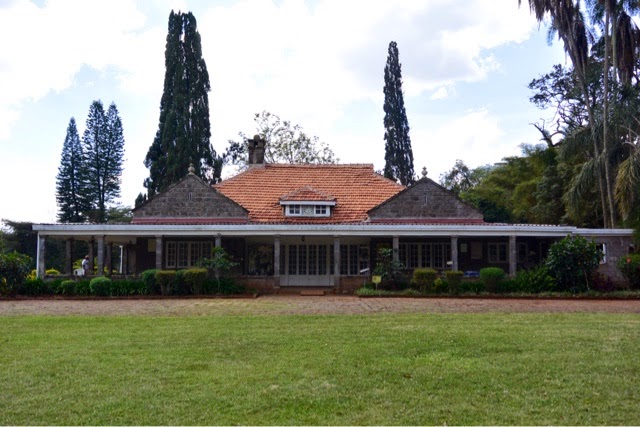
My last stop of the day was the Karen Blixen House. This is the woman who wrote Out of Africa, which was based on her life story. She lived here from 1914-1931, and left quite a legacy behind her. The museum was her house, and is situated on a beautiful plot of land. Unfortunately, I wasn't allowed to take any pictures inside the house.
All in all... what a spectacular first day in East Africa!


Kerak Castle and a float in the Dead Sea

On our way to the Dead Sea and Madaba, we stopped off at Kerak Castle, one of the 3 largest in the region (The other 2 are in Syria). It's an old crusader's castle, though parts of the structure and inhabited area date back to the Moabites in the Stone Age. This is where Syrians settled before going North of Palestine. There are some inscriptions that were found dating back to the 9th century BCE. 
The castle has been under the control of the Nabataeans, the Romans, the Byzantine Empire, and the Crusades. 
Below you can see some of the wheels once used for pressing olives. 
The back wall here is the giant oven. 
With several sections once surrounded by a large outter wall, this was once a impressive and well fortified stronghold. 
From Kerak we travelled on North, to the Dead Sea. It was really quite beautiful, and the day was clear so you can see across the water to Jerusalem.  
Although the others got some good photos of me really floating, this is the only one that I currently have. It was SO. MUCH. FUN though!! The water is very strange and has an oily quality to it when you come out of the water. Incredibly viscous. You get into the water, and you just...float. And by that, I mean, it's near impossible NOT to. You can tell in the phot below, as I tried to stick my arms and legs out of the water at the same time to show just how much I was floating, the buoyancy of it all made me start to flip over. 

The whole group just laughed like kids as we tested the water. It took serious core strength to try and put your legs straight down and keep yourself vertical, and the same was true for trying to roll onto your stomach and just stay there. Everyone else that was in the water seemed calm and collected about the whole experience, but my little group reverted to just being children. It was fantastic!!!  


Monday, November 10, 2014

Petra- (Take 2- Beyond the Treasury)

Coming to Petra, I really had no clue that this was so much more than just the beautiful slot canyon that leads to the Treasury. (Damn you, Indian Jones, for coloring my views!) It is, in fact, a huge and sprawling area that was once a great city that stretches out for many miles in all directions past that canyon.

Evidence has shown that people have been living in the area for the past 7000 years. By 312 BCE it had become Petra, a major city on the caravan trade route, and the capital city for the Nabataeans. In 106 AD it became absorbed into the Roman empire, becoming the capital for Syria and the Arabian area. Around this time the roads, including the siq, were all paved. However, in 363 AD there was a massive earthquake, damaging much of the city and the integral water systems. The city continued to fall into decline with the Romans moving to sea-trade routes, and in 663 AD another earthquake left the city in complete disrepair. By 700 AD the city was abandoned by all but the Bedouins in the area. 

Some brief mentions of the city appear here and there, the last being in the 13th century. However, the city was then forgotten about and lost for the next 600 years. It wasn't until 1812 when a Swiss explorer went looking for the city was it found once again. 

Seen below, this is the view from far above in the mountians down to the canyon. 
Directly after the Treasury, you walk into the Street of Facades, which is a series of large tombs that line either side of the roadway here. Again as in the siq or area around the Treasury, the ground level has raised considerably over time and now you can just see the tops of the doorways to some of these tombs. 
Others, however, were built high up into the rocks. 
Further down into the city, you can see what remains of a huge theatre. This pre-dates Roman theatres and was built by the Nabataeans. 
Everywhere you look though, there are more and more tombs to be found. 
Across from the large theatre you can see the grand Royal Tombs. 
Though tombs can be found everywhere you look....
From this area, I climbed up to the High Place, which was once a sacrificial place on the top of one of the hills in the area. The vantage point as you climb is really amazing. 

From the top of the High Place you can really get a spectacular view of the royal tombs as well. 

Climbing down from this vantage point, there were even more caves and tombs to be found. 

Some, like the Soldier's Tomb below, still have statues visible on them. 
While others just have amazing colors in the stone. 
While walking around Petra today (We were given a "free day" to do what we liked, so no group) I somehow picked up a Bedouin. I wasn't thrilled at first to be followed around by a guy for the day, but, well... I couldn't seem to shake him (In fact, I had "met" him the night before going into the siq for the candlelight walk. He had told me that I should come back to the Bedouin camp that night afterwards for dinner with them. I declined.). Figuring that I should just go with it because at the least it would be an interesting day, I relented to letting him lead me around and/or follow me for the day. 

After coming partway down from the High Place, we diverted off the main road and went back up into another series of hills to some caves. Although the Bedouins were asked to leave and given a plot of land and housing nearby by the King of Jordan when Petra was declared a World Heritage site, there are still some Bedouins who live in the caves. This Bedouin and his friends are just such people, and he took me back to see his cave. (Yes. That's what I said. He asked me back to his cave.) 
I wasn't sure what to expect, but when we got inside, this is the beautiful little area that I saw. We sat down on the floor and he made tea. (I honestly had so much tea that I could have floated away. Each new Bedouin we met, we had tea. Every stand, every hut, every cave....it was a lot of tea.) As we sat on the floor talking, it was truly a lesson in living simply. As he put it, "You die with nothing. Everybody dies with nothing. Why do I need more? I am free." 
I was also given my Bedouin name. *I have absoluely no idea how to spell this, so I will try phonetically* He said my name was "Gamaar" which means "Moon" (Because "you are white and beautiful.") However, when we later ran into several of his friends and sat around- with another cup of tea- they said that that was too generic and amended it. It was then generally agreed that my name would be "Gamaar Jeydadth." There's no real translation in English for "Jeydadth," but it was explained to me as "the sky just before the sun rises." So, my name means "The moon just before the sun rises." 

I can live with that. 

As we climbed down the hills from the caves, we came across the Colonnade Street. This roadway once had hundreds of columns lining either side. 
Looking across this small valley you can see what was dubbed as "The Great Temple." However, historians are now wondering if this was in fact the seat of the Nabataean government. 
From the hilltop where I was though, you can see the Mosaic Church. This structure still houses an incredible mosaic floor. The fact that any of this has survived through time is really impressive, as is the detail of the floor itself. 


Moving further along on the side of the valley from this church, you can get a much better view of the Great Temple. You can see it was a multi-level structure. 
Just to the other side of the Great Temple you can see the largest building with the largest facade in Petra, the Temple of Dushares. The wooden beams that were in the walls to help originally erect and maintain the height of this structure are what have saved it from destruction by the earthquakes over the years. 
Before going on and up the 800 staris to the Monastery, my little Bedouin friend took us on another detour to show me the natural springs they have. We went well off the regular paths, and past more caves- larger this time- where people were clearly living. This one seemed to house a whole family, along with chickens, a goat, some donkeys, and laundry hanging out to dry. 
Walking further down this new canyon area, things began to get greener and greener. 
I even got to see where the Bedouins are terrace farming things like olives, lemons, and apples- though it got harder and harder to take pictures as there wasn't much clearing as we went further in. The springs are actually very large and very deep pools. I was told I could go swimming in them if I wanted, but somehow I figured taking off my clothes would be a very bad idea....
Walking back towards the main path to the Monastery, my friend started to become a bit handsy, venturing to put his arm around me and trying to get me to stop and "look at him." After an attempt at holding up my ring (I always travel with a wedding ring on. It usually works to just say "married!" to men and they walk off. Plus, it really is just a layer of security if people think that there's a high probability that you'll be missed.), but this guy wasn't having that at all. So, with a faster pace and a thanks-for-the-tour, I told him I was going to venture the rest of the day on my own. 

And up to the Monastery I climbed. 
I really didn't know what to expect once I got up to the top... and it really is over 800 steps. You're high up into the mountains around you once you reach the clearing at the top, but your climb is rewarded with a really impressive sight!


You can climb up a bit further as well, and really get a spectacular 360 degree view of the whole area. 

Climbing back down again, I made my way back towards the Royal Tombs, to go and explore some more there. From the left, you can see the Palace Tomb, the Corinthian Tomb, and then the Silk Tomb is nestled back in further down. 
The Palace Tomb is clearly the largest, and possibly would have been the most ornate. 
The Corinthian Tomb resembles the Treasury fascade quite a bit. Some historians believe that this was the "test run" for the design of the Treasury. 
Looking out from these tombs:
The Silk Tomb, which was named for the beautiful array of colors sweeping across its face.
And here from inside the Urn Tomb you can see even more beautiful colors and patterns across the ceiling. This tomb was converted into a church later in its life, with an inscription in the back saying it was consecrated in 447 AD.
This is the outside view of the Urn Tomb.
And again, walking back out and back towards the siq, I was struck by the miriad of colors across and through this beautiful and timeless city. 
Beyond my wildest expectations, Petra holds a special place in my heart. What an incredibly wonderous world we live in.